


As 2025 wraps up, it’s clearer than ever that out-of-home (OOH) advertising is evolving at full speed. As brands look for high-impact ways to stand out beyond crowded feeds and algorithm shifts, OOH has reclaimed its spot as the creative playground everyone’s talking about. Digital screens have become smarter, static formats have become bolder, and campaigns have become more interactive, contextual, and culturally relevant than ever before.
From large-scale 3D executions to simple concepts placed in the perfect location, this year proved that OOH remains one of the strongest ways to make an impact in the physical world.
Canva brought design drama to the street


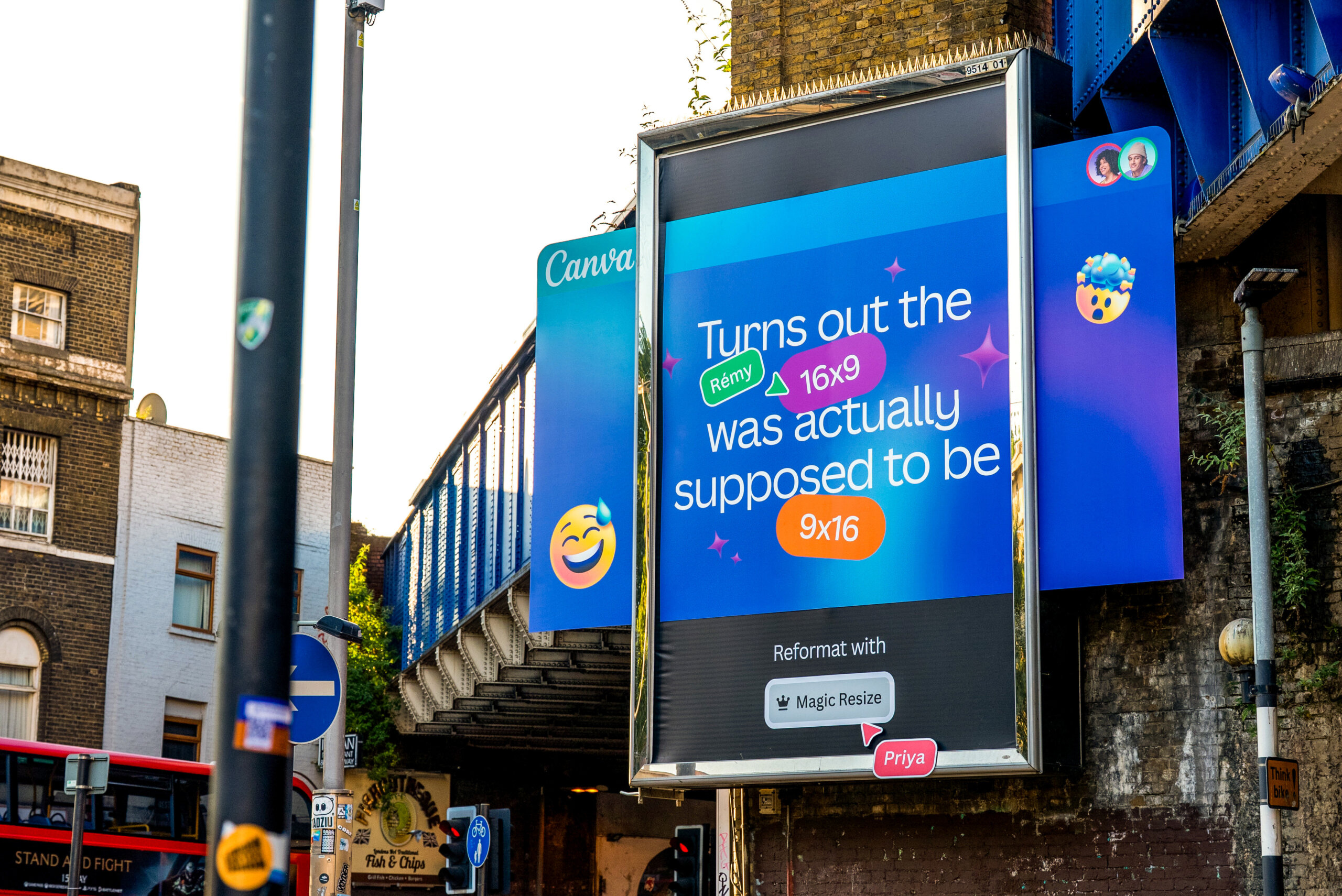
Canva took a classic piece of feedback that haunts every designer and turned it into one of the most entertaining OOH campaigns of the year. Around London’s Waterloo Station, the brand displayed static billboards playing with classic creative struggles like mixed-up aspect ratios, overzealous background removal, conflicting feedback, and reformatting mishaps.
With taglines like “make the logo bigger” and “turns out the 16 by 9 was meant to be 9 by 16,” Canva set out to show that it understands the everyday realities of creative work and highlight its platform built for modern creators who want to simplify the process without losing the fun of making something. By putting these moments out in the real world, Canva proved that OOH is the perfect medium for turning creative chaos into something instantly relatable and impossible to ignore.
Selleys proved its strength
Selleys put its Liquid Nails adhesive to the test in a big way this year, gluing a kayak, an arcade machine and even a 2.8-metre marlin to an outdoor billboard and inviting the public to try pulling them off. The Australian brand, best known for its wide range of adhesives and sealants, kept the premise simple: if you can take it, it’s yours.
Crowds showed up eager to try, tugging and prying in hopes of winning a free prize. Not a single person succeeded, reinforcing the brand’s long-standing promise that if it’s Selleys, it works. The stunt quickly gained traction online as creators shared their attempts and failures, sparking conversation across Australia. This OOH execution really stuck.
Cluely skipped the flash while still making a big impression


Times Square is usually a battleground of high-budget visuals and over-the-top creative, but Cluely, an AI assistant startup, decided to play the opposite game. Instead of pouring money into flash, the brand went all-in on understatement. Their DOOH activations, sitting in one of the priciest ad locations in the world, were nothing more than a stark white background with a few lines of plain black text:
hi i’m roy im 21
this was very expensive
pls buy my thing
We loved how the campaign stood out simply by refusing to compete with everything around it, making it instantly shareable and impossible to ignore.
Greenpeace staged a silent protest inside DOOH screens


Greenpeace and creative agency Elvis launched one of 2025’s most provocative DOOH activations with “They Can’t Arrest This Billboard”, a synchronized digital protest across high-traffic screens in London, Birmingham and Manchester. Taking a stance against the UK’s tightening protest laws, the campaign placed real activists inside DOOH screens, representing the kind of peaceful protest that could put them at risk if they were standing on the street.
Each display showed full-motion portraits of protesters holding placards reading, “I’m protesting in here to avoid arrest out there.” As audiences moved through each city, they encountered a rotating sequence of activists, creating the feeling of a silent march unfolding within the screens. The campaign was a great reminder that OOH remains one of the few mediums capable of bringing real-world issues directly into public view.
Polaroid snapped people out of their scroll


Polaroid’s “The Camera for an Analog Life” campaign brought us a refreshing dose of real-world charm this year. With OOH ads activated across major cities worldwide, the photography and electronics company encouraged people to look up and re-engage with the moments around them. Copy lines like “AI can’t generate sand between your toes”, “real stories. not stories and reels”, and “no one on their death bed ever said: I wish I’d spent more time on my phone” were paired with actual Polaroid shots to showcase the tactile experience the brand is famous for.
The campaign extended into phone-free walking tours in cities like Paris, Tokyo, London, and New York, where people locked away their devices, explored with a Polaroid Flip camera, and even mailed their photos as postcards. We enjoyed how the billboards cut through crowded urban environments by asking passersby something simple: pause, notice, and be present.
The Guardian told the whole story


To mark its American expansion, British daily newspaper The Guardian launched its first major US campaign under its ‘Journalism that’s global, independent and free’ message. Billboards across New York City appeared with large sections of copy covered in black tape, leaving only a fragmented phrase visible and hinting at censorship in American news. Pedestrians were then invited to peel the tape away themselves to reveal the full statement, making the point literal: The Guardian may not have the size or wealth of other US outlets, but it does have independence.
The installation ran across subway platforms, digital screens and high-impact outdoor boards near Madison Square Garden, part of a broader effort to grow American readership. It was a strong reminder of how OOH earns attention when the medium becomes part of the message.
Audi turned horsepower into harmony
Audi’s “Engine Symphony” campaign turned the sounds of its RS models into sheet music, swapping the usual displays of power for something more refined. The campaign also included a short film that opened on the horsepower score before cutting to composer Ben Parry at work, translating the engine’s acoustics into notation. It then revealed those same sheets installed across OOH sites, highlighting how sound is an essential part of the driving experience.
Digital OOH screens displayed the compositions near the UK’s final concerts of the summer season, with each score titled by horsepower and paired with its RS model name, connecting directly with classical music fans already tuned into craft and performance. This one definitely struck a chord in our books.
Decathlon brought its snorkel star back to the surface


Decathlon marked the tenth anniversary of its bestselling Easybreath snorkel mask with an OOH activation that was impossible to miss. In partnership with JCDecaux Netherlands, the brand installed oversized 3D replicas of the mask at two of the busiest spots in the country: Grote Marktstraat in The Hague and Amsterdam Central Station.
Each installation featured the face of a snorkeller printed on the billboard. An oversized Easybreath mask sat on top, extending past the frame, with the snorkel lifting upward like it was breaking the surface of the water. The effect was playful and hard to ignore, quickly stopping people in their tracks. Subtle digital touches heightened the illusion, making the mask feel as though it was floating or emerging from the waves. This anniversary stunt definitely rose to the surface.
UNICEF turned Helsinki’s DOOH screens into real-time alerts for Ukraine
UNICEF Finland launched a powerful DOOH campaign that streamed real-time air raid alerts from Ukraine onto digital screens across Helsinki. The initiative tapped directly into data from Ukraine’s official Air Alarm app, pulling alerts from six major cities. Whenever a siren sounded in Ukraine, the message appeared instantly on billboards throughout the Finnish capital.
The campaign served as a stark reminder that the war is far from over and that children in Ukraine still need support. Each alert included a MobilePay number for donations, turning those notifications into an immediate opportunity to help. Finland’s major OOH operators, including JCDecaux, Bauer Media Outdoor, Ocean Outdoor and more, joined the effort at no cost, allowing the alerts to appear on nearly every digital screen in the city. It was a strong example of how DOOH can connect audiences to global events and create meaningful opportunities to support.
KFC Canada got a hockey makeover

KFC Canada kicked off hockey season with a clever twist on one of the most recognizable faces in fast food. In partnership with its agency Courage, the brand removed its iconic Colonel’s two front teeth using hockey tape, giving him the unmistakable grin fans associate with the sport.
The campaign, titled “The Hockey Smile,” included OOH ads across Canada alongside other placements like in-store signage, takeout buckets, social media, rink boards, jumbotron moments, and even sponsor segments. Anywhere hockey fans looked, the Colonel smiled right back, proudly missing two teeth. We love how this showcased that OOH can bridge brand storytelling and fan culture in an authentic way.
Disney’s Percy Jackson promo made a splash (literally)
Disney’s Percy Jackson and the Olympians promoted its second season in a big way this year: a 4D billboard in the heart of Hollywood that actually splashed water in sync with the on-screen action. Installed at the iconic Hollywood and Vine corner, the OOH display doubled as a functional water tank, complete with mist effects and fountains timed to the newly released Season 2 trailer.
Whenever water crashed across the digital creative, it spilled over in real life too, transforming the sidewalk below into a waterfall. Crowds gathered throughout the day to watch the ad come to life, and within twenty-four hours, the activation had already gone viral. Safe to say, this one soaked up all the attention.
Tim Tam brought a taste of Down Under to the UK

Tim Tam, Australia’s beloved chocolate-covered biscuit, made a memorable entrance into the UK with a campaign that fully embraced its “Down Under” roots. Working with independent creative agency Insiders, the brand set out to remind Brits that Tim Tams are now available nationwide, a fact many still didn’t know, despite the biscuit becoming the fastest-growing brand in the category since its UK supermarket debut in March 2024.
The idea was simple: flip the billboards upside down. The playful twist leaned straight into the brand’s Aussie identity while giving audiences something unexpected enough to make them stop and look twice. Using Tim Tam’s signature chocolate-brown packaging, close-up product shots and witty lines, the executions were intentionally designed to tap into the brain’s instinct to refocus. It was a smart (and delicious) attention strategy.
TD encouraged us to “own a piece of it”


TD made investing more accessible with a clever OOH activation that turned everyday window shopping into a lesson in fractional investing. Across Canada, street-level urban panels in the bank’s signature green appeared in high-traffic areas, each featuring a tiny window cutout that offered just a fraction of a view into brands like Apple, Google, Starbucks, and McDonald’s.
By placing these ads in environments where people naturally slow down and look around, TD created a simple but powerful visual metaphor for fractional shares, showing Canadians that they can own a piece of their favourite companies for as little as a dollar. And with TD as the only bank-owned brokerage in the country offering partial shares, the message landed with extra impact. We thought it was a standout reminder that simple, contextual OOH always owns the moment.
Billie gave OOH a fresh new scent

Billie brought an unexpected twist to the streets of New York City with a billboard featuring a giant armpit you could actually scratch and smell. The skincare brand used a custom scratch-and-sniff surface to let passersby test its new Coco Villa deodorant right on the spot, a playful and very literal product trial delivered through OOH.
Once scratched, the billboard revealed the deodorant’s tropical scent profile, a standout example of multi-sensory OOH. To extend the buzz, Billie also mailed replica posters to influencers and media outlets, helping the idea spread online. The campaign went viral almost instantly, racking up millions of views across TikTok and Instagram Reels. It was a smart reminder that sometimes the best way for a brand to stand out is by inviting people to get up close and personal.
Oura gave us the finger (but it’s not what you think)


Oura, the health-technology company best known for its Smart Ring, launched a new campaign called “Give Us the Finger,” aimed at shifting the conversation around aging. The idea centers on the index finger, where the ring is worn, but also on redefining what it means to grow older with confidence, intention and pride.
Across Los Angeles, New York, Miami and London, OOH ads featured real people in their 40s through late 70s doing the things they love like dancing, playing chess, hiking, and more. The large-format placements spotlight confident adults holding up their index finger, showing the ring and sending a clear message that aging is something to embrace, not avoid. Nice one, Oura.
Tata Coffee Gold brewed up a multi-sensory 3D DOOH experience
For International Coffee Day, Tata Coffee Gold invited shoppers in New Delhi to experience coffee in a completely new way. The brand installed an immersive, multi-sensory OOH installation that brought the journey from bean to cup to life.
Audiences followed a cinematic sequence showing a green coffee bean being roasted, brewed and freeze-dried into Tata Coffee Gold’s signature crystals, all unfolding on a large 3D anamorphic screen while the smell of fresh coffee filled the space. The experience also included a personal touch. Guests could enter their name, snap a quick selfie, and watch it transform into custom AI-generated latte art. A QR code let them save the moment before receiving a hot cup of Tata Coffee Gold to complete the activation. Safe to say, this one gave International Coffee Day a little extra buzz.
Aktion Baum gave us a frightening look at the effects of deforestation


This Halloween, Aktion Baum, a German NGO working to combat forest decline, used the holiday’s spookiness to spotlight something far more alarming: the rapid deterioration of Germany’s forests. It was a sobering display; despite covering a third of the country, more than 79 percent of its forests are now diseased.
The campaign leaned into familiar Halloween scenes, using eerie retro VHS-inspired visuals and taglines to make people confront an unsettling possibility: a world without trees is a world without a future. Each DOOH ad featured clear CTAs and QR codes directing viewers to donate, plant trees or join Aktion Baum’s reforestation programs. Titled “Trick or Tree?”, the campaign ran across Germany throughout October, turning a seasonal moment into a powerful call for environmental urgency.
Cats scaled London billboards for Dreamies treats

Dreamies, the global cat treat brand (known as Temptations in some markets), took over London with a playful OOH stunt showing just how far cats will go for their favourite snack. In a campaign by adam&eveDDB, oversized 3D cats appeared climbing buildings, hanging off ledges and stretching toward an oversized pack of Dreamies perched just out of reach.
Part of Dreamies’ “Cats Will Do Anything” campaign, each installation was built from 3D models of real cat poses and then hand-painted for a lifelike finish. The result turned the billboards into playful snapshots of determined cats doing whatever it takes to get their treat.
Squid Game Season 3 levelled up in 3D
To build excitement for its third season, global television phenomenon Squid Game launched an anamorphic DOOH takeover at Shinsegae Square in Seoul as part of a global collaboration with Netflix, Palomino and Cheil Worldwide. The campaign introduced a new Season 3 challenge, the Jump Rope, using high-impact 3D-style creative to bring iconic Squid Game imagery to life.
The ad opened with a wrapped present unboxing itself before revealing the Front Man, one of the show’s most recognizable characters, then moved through familiar scenes and players, ending with a cue that Season 3 was now streaming. We love a great use of 3D in DOOH, and this campaign delivered.
Grubhub satisfied our hunger for good OOH


This year, food ordering and delivery platform Grubhub’s “Summon the Food” campaign leaned into the idea that cravings should be met with instant satisfaction. Created with independent agency Walrus, the campaign ran across New York and Chicago, highlighting how quickly the app connects people with the food they’re in the mood for.
One of the standout executions was in Chicago, where a giant 3D grilled cheese appeared to melt right into the bus stop below it. In New York, oversized mozzarella sticks stretched across a long billboard inside the Oculus, turning the space into a full-on cheese moment. It was a great reminder that the right creative just hits the spot.
Virgin Active gave wellness burnout a much-needed rest day


Virgin Active used World Mental Health Day to push back on the pressure-filled side of wellness, spotlighting the rise of “wellness burnout” and encouraging a more grounded approach to fitness. As part of its ongoing “Where Wellness Gets Real” platform, the latest phase of “Leave the Cult, Join the Club” campaign reframes rest, balance and recovery as core parts of wellbeing, not signs of a lack of discipline.
The work appeared across OOH, digital and radio, with Virgin Active clubs around the world leaning into relaxation and recovery to reinforce the message. In London, the campaign extended into the Royal Parks Half Marathon, where 16,000 runners and tens of thousands of spectators viewed ads that flipped classic fitness clichés on their head at mile markers and cheer zones. Post-race billboards poked at the relentless “no rest days” mindset, while a branded Recovery Zone offered runners a literal and figurative place to slow down.
Hatch told everyone to put the phone to bed


Hatch delivered one of the cleverest wake-up calls of the year with a billboard placed directly beside an iPhone ad. The board pointed straight at Apple’s creative with the line “Will let you text your ex at 2 AM,” setting up the sleep brand’s broader message that “a million things do not want you to sleep. Hatch does.” For a brand built around better rest, it was an ideal way to nudge people away from late-night habits and toward healthier routines.
With the placement doing the heavy lifting, the ad showed how context can turn a simple billboard into a moment that stays with you. A sharp reminder that in OOH, the right location can truly be the dream maker.
KitKat reminded us to take a break (or two)


KitKat’s “Phone Break” campaign, created alongside VML Czechia, took the chocolate brand’s iconic “Have a Break” slogan and reinterpreted it for an era of constant scrolling. In a series of OOH executions, smartphones were swapped for KitKat bars in everyday moments where people instinctively reach for their devices, like waiting for a bus or standing in line.
The campaign ran across billboards, subway stations and other busy outdoor spaces, using imagery so instantly recognizable that KitKat never needed to show its famous tagline. It even won the Cannes Lions Outdoor Grand Prix this year. KitKat really took a break from the ordinary with this one.
The Alzheimer’s Foundation used a familiar digital moment to illustrate memory loss

The Alzheimer’s Foundation of Sweden’s (Alzheimerfonden) latest campaign, created by Stockholm agency Kid, uses a simple digital moment we all recognize: the buffering wheel to convey something far more impactful. Across the DOOH ads, family portraits freeze mid-load and faces blur behind that familiar spinning icon, turning an everyday digital delay into a clear reflection of how memories can slip away.
The work ran across donated digital billboards from Ocean Outdoor, national TV and social channels, helping the Foundation reach audiences at scale. It also highlighted an important reality: more than 160,000 people in Sweden are living with dementia today, and that number is expected to double by 2050. There is still no cure. By using real photos of loved ones affected by the disease, the campaign turns a common loading icon into a clear reminder of what Alzheimer’s gradually takes from families and why continued awareness and support matter.
HOKA turned a Manhattan block into a living desert


To celebrate the launch of the new HOKA Mafate X trail shoe, the American running brand did something New York had never seen: it brought the desert to Manhattan. For 48 hours, a city block became an immersive Joshua Tree–inspired landscape, complete with native flora, heat, wind, rocky terrain and a lone treadmill at its center.
Runners stepped off the sidewalk and instantly felt the shift, with rising temperatures and layered desert sounds pulling them deeper into the experience. Behind them, an Unreal Engine–powered backdrop generated desert trails in real time, matching each stride. The faster they ran, the faster the scenery moved, with the lighting moving from morning, noon, and dusk to ensure no two runs were alike.
Between sessions, the installation transformed into a massive 3D billboard featuring Mafate X visuals and footage of elite trail runners, turning the space into a standout OOH moment for anyone passing by. We love it when OOH becomes an immersive experience, and this one definitely went the extra mile.


